Monday, February 27, 2023
Time for a Dignified Retreat in the Face of Climate Disruption
For many years now, this blog has swung between deep pessimism
about climate disruption and study of possible techno-fixes. The most time-consuming of those periods of
study was 2006-07, when I took off six months to study nuclear power. My conclusion was that, despite the manifold dangers,
it was worth the risk, given the certain doom of fossil fuel addiction. This was not a popular position at the annual
Quaker Earthcare Witness meeting, and some folks were looking daggers at me
when I refused consensus with their public statement about its dangers, which
my study showed me included errors and lies. Fifteen years later, world reliance on nuclear
power has lessened, and we have produced as much CO2 since 2000 as we did from
the outset of the Industrial Revolution, 1790-2000.
But I have always returned to my dark roots, and that has
happened again. Led by the indefatigable Michael Dowd, I have encountered the work of Dahr Jamail, whose book, The End of Ice, is the latest in a series of books that
have profoundly influenced me with respect to climate disruption. Each time I read accounts of the latest
science, I face anew the starkness of our future as a species, and of whole
pieces of the biosphere. In the case of
Jamail, meticulous journalism is combined with personal history and a
willingness to record his feelings about our dilemma– and crucially, those of the
scientific experts he interviews. Jamail
models for me personal practices (he might agree with the broad term “spiritual”)
of going to the woods when he reaches overwhelm, and going through grief, fear,
and anger, rather than walling them out. For these reasons, I find his truth-telling
unparalleled in my extensive study of climate science during the last
twenty-odd years.
In addition to Ice, there are two fine Jamail interviews,
one with Dowd, another with Carolyn Baker and Andrew Harvey. Other extremely helpful interviews in Dowd’s “Post-Doom”
series are those with Jem Bendell (“Deep Adaptation”) and the droll and thoughtful
Alan Weisman, author of The World Without Us.
Last night, I read Jamail's devastating chapter on the imminent
loss to seal-level rise of the Everglades, along with virtually all of South
Florida. In his interviews with engineers,
city planners, and scientists in the greater Miami area, he encounters some
deeply responsible public officials whose response to the frightening sea-level
data is to create a timeline and budgeted priorities in abandoning property prudently
and responsibly. This includes a seaside
nuclear reactor site at which the NRC has approved adding another reactor! As I
read these encounters, I realized that they were outlining a third position to
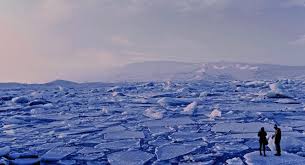
my own polar travels. That is a position of orderly and dignified retreat,
modeled especially by the mayor of South Miami, Phillip Stoddard, who is also
professor of biology at Florida International University. Continuing denial, or unqualified optimism, will only lead to the kinds of chaotic responses that have characterized most of our "adaptive" responses to date.
This is an unglamorous position, and very hard work, especially
in an era of continuing Republican denial and the generally inconsistent
response to climate and other ongoing large dilemmas that populist politics has
mired us in. But it is an admirable response, both practically and morally,
which one can contrast with both doomer “quitting” and activist eleventh-hour
behavior when midnight is baked into the pudding. (The key data here is that every 100-ppm CO2 increase in the atmosphere produces 100 feet of sea-level rise. At 410 ppm, 130 feet of sea-level rise is insured, no matter what happens with future emissions Ice, 130-31. I'll leave it to my readers to check the elevations of the world's major coastal cities.) This is responsible behavior in terms of humanity,
but also in the interest of the beings involved in the holy mystery of ongoing
evolution. The overarching vision is described
in E. O. Wilson’s sublimely optimistic Half-Earth (now whittled down to "30-30"), highlighted
by such efforts as planting trees poleward to insure
the best possibility of their surviving the current Sixth Extinction.
Labels: 30-30, Dahr Jamail, End of Ice, EO Wilson, Everglades, Half-Earth, Miami, Michael Dowd, sea level rise, sixth extinction, South Florida
Thursday, September 13, 2018
The Great Filter...and Beyond
I
must confess to feeling like I’ve been traversing a morass, the
molasses-tarbaby into
which I fell in the last
post. The whole point of “Losing Earth” and its critics is to
assign blame for our apparent failure to steward the Earth and to
steward a future for our offspring. I found myself agreeing in some
ways with both sides, thus the tarbaby.
But
what if there is no blame at the level of either individual choice or
social system/policy? There may well be something at the species
level that dooms us to prefer maximizing present advantages to
planning for a longterm future we can neither
understand nor
imagine. This is the position of Craig Dilworth, and I have yet
to read a a cogent counterargument to his Too
Smart for Our Own Good.

Another line of thinking derives
from Fermi’s Paradox, the apparent contradiction between the high
probability for the existence of extraterrestrial
civilizations
and the lack of evidence for them. As Fermi said, “Where is
everybody?” Robin Hanson and Glen Brin have responded with the
idea that the Great Silence with which we are greeted from apparently
dead space is caused by the “Great Filter”: it is in the nature
of advanced civilizations to destroy themselves before they get to
the point of colonizing other suitable planets. This occurs either
by (something like) nuclear
war, ecological collapse, or simply because complex civilizations fall victim to their own complexity.
One writer noted that the success of complex civilizations means
that they grow until they outstrip their energy resources, and in the
process doom themselves to death by carbon.
Advanced industrial civilizations
extract so much from their planetary base that they eventually
destroy their very conditions for life. If life on other planets –
and the odds are huge that it is commonplace in the universe – does
not reach the level of interplanetary communication or travel, then
it is either because it never reached the level of complexity of our
global civilization,
or it was able to restrain itself before it reached the Great Filter.
Many Hindu sages
point to the legend about
their ancient
forebears backing
off rocketry, because ancestral
sages foresaw the inevitable
results. This may not be
true, but respect for wisdom, rather than power, would certainly rein
in the potential for a civilization to project itself far into
interstellar space. But look
at India now, trying to be like the US as fast as possible, and using
more coal per energy unit than any other nation on Earth.
In the case of the lost
decade in the Climate Wars,
it is not neoliberalism per
se that was
the culprit. The
socio-political
structure was going to
somehow manifest
this flaw in hyperadvanced higher life forms.

I am a deeply spiritual person, and
I agree that the spiritual maturation of the species would mean that
anthropogenic climate change would never have become our endgame.
Nobody wants to give up on
the prospect of breaking
through to the level of species wisdom for which I referenced Joanna
Macy’s comments in my last post. As Thomas Berry wrote in The
Great Work, we need “to
reinvent the human at the species level.”
But when
Gary Snyder was
asked about when he thought
humans would reach that level, he answered with a chuckle, “ten
thousand years.”
In
the meantime, what do we do now? E.O. Wilson keeps emphasizing
conserving hotspots (his latest, perhaps bravest book is Half
Earth, arguing for putting half of the Earth aside for other
species). We will not be able to preserve coastal cities,
grainbelts, and fisheries. Conserving genetically diverse hot spots
will help prime the evolutionary pump for the next efflorescence, the
rapid speciation which will follow, when the time is ripe, the
current Sixth Extinction.
Even
if it is too late to save civilization, which has not been so kind to
the Earth community, even if we have broken our covenant with the
Unnameable, those of us who are faithful need to avoid cynicism and
despair. (Not easy, my friends!) We need to live and work as if
we were in covenant relationship with God. We need to
work to restore the covenant, recognizing that this will not bear
fruit in this incarnation of higher life. The end is near, and the
future will unfold, but living in affirmation of that future,
preserving what we can of gene pools and best practices, even as the
culture for those practices heads into its death spiral, is the task.
This is the huge role of spiritual leaders, conservationists,
traditional culture bearers, teachers, and honest, caring writers and
artists.
It is unutterably sad to observe
that the desperately needed transformation of humans simply has not
happened quickly enough to avert climate catastrophe. I mourn the end
of the holocene period and
the splendid, diverse
array of life the
era which
has been our home, the cenozoic. But the basis for
true hope lies in the regenerative potential of evolution on Earth.
In the end, we must not read
Biblical hope locally in terms of life in the holocene, or even in
terms of Earth. history
The Creator is not simply a middle eastern sky god hanging out in an
Islamic Paradise Garden trying to manage his wayward children. “He”
is the Unnameable,
creator and lord of worlds upon worlds, with no limits. Not
only does She (It)
not look
like your grandfather; God
isn’t even a noun, which is form of hypostasy and idolatry.
Godding (GK Chesterton)
is the process by which the indwelling Source manifests itself
throughout Creation.
I
have many conversations these days with folks where we agree that
those of us alive today will neither save nor lose the Earth, for she
will endure. The biggest fault in the Nathaniel Rich piece is in the
false title, chosen for dramatic effect, “Losing Earth.”
Balderdash. As I have posted here before, there are one to two
billion years of evolutionary history ahead of us on this sweet spot
in the Universe. And now astronomers and astrophysicists are
realizing another insight of the ancient Hindus, that the universe is
not a one-time event. It is not a Big Bang as much as a Big Bounce.
The cosmological theory that has reigned during my lifetime is fast
being replaced by one that fits the facts better. The universe
appears, ends, and reappears. It is regenerative. That is another
story, one which both reinforces a sense of covenant stewardship
towards the Deep Future and helps us forgive ourselves for failing
this time around.

Labels: Big Bounce, covenant, Craig Dilworth, EO Wilson, Great Filter, Hindu rocketry, hot spots, Joanna Macy, Robin Hanson, Thomas Berry
Tuesday, January 31, 2017
Shock and Awe
Like most of you, I
am absolutely stunned by Donald Trump's shock and awe campaign. He
wields the executive pen like a kid in a candy shop. Not only is he
delivering on his abominable campaign promises, he's added nasty
surprises like proposing to sell off public lands. Congress has
already changed the rules to make it easier for him to do so. These
lands are the foundation of the modest beginning for EO Wilson's audacious, noble proposal to set aside half the earth for
wildlife to recover from the ravages of human-driven extinction.
One quickly realizes that it's not only the efforts to combat
climate change that his actions put at risk, but the protection of
habitat against the assault on wildlife. And he includes the National
Parks, our national treasures, in his inventory of real estate on the
block. Park Rangers (my son Jesse is one at Yosemite) have
courageously resisted his gag order, and the NPS chief has issued a magnificent rejoinder to our demagogue president.
It is hard to
imagine a worse set of cabinet picks, and the Senate is not showing
the backbone on either side of the aisle to stand up to him. He
bullied and lied his way – and worse – to election, and now he's using the same tactics as President,
relentlessly tweeting his “alternative facts.” More subtle
tactics are being employed by the true masters of propaganda, the
Russians, to convince the majority of it's citizens to acquiesce to a
totally false narrative about the historical and current realities in
their country, but Trump's moves in the same direction are chilling.
We must resist, and never tire of it.
Trump's narcissistic
lying means that nobody, friend or foe,can trust his word. This has
potentially catastrophic consequences. By continuing to belittle
NATO, he threatens the future of peace in Europe, with NATO members
Latvia and Lithuania looking like easy pickings for an emboldened
Vladimir Putin. If NATO does not resist their takeover, it is not
only obsolete, but dead. Meanwhile, Trump and Rex Tillerson are
rattling sabers over China's claims in the South China Sea, risking
war between major nuclear powers. John F Kennedy, a seasoned
politician with diplomatic skills, similarly risked nuclear war with
the Soviet Union over their Cuban missiles. But Kennedy was
reasserting the longstanding policy of control of our neighboring
waters declared in the Monroe Doctrine. Can our leaders not see that
China, as an established world power, has similar interests in their
own backyard pond? It is important that the World Court in the Hague
has ruled against their claim, but the Philippines, whose territorial
waters have been violated, has absolved China. We cannot afford to
police the world indefinitely. Are the South China atolls and
fortified reefs in our “core interests,” as China claims for
itself?
But can we count on
President Trump even knowing what the Monroe Doctrine is? Perhaps,
since he has delegated national security briefings to his
vice-president, he can have Pence do the research for him on our own
geopolitical history. After all, we shouldn't expect knowledge of
political science or policy matters from a real estate mogul and
reality tv host with the emotional intelligence of a six year-old (by
his own admission ).
From my perspective
as a climate journalist and activist, the ascension of an outright
climate denialist, with cabinet choices of a half-dozen more,
completes the campaign of disinformation mounted by the fossil fuel
industry, aided and abetted by virtually the entire Republican Party.
The rest of the world stands in absolute disbelief that the world's
leading power, with a strong postwar history of helping the recovery
of defeated nations and development of the Third World, has turned
its back on the future of civilized order on this planet. The tragic
irony is that this is occurring after a reluctant US finally was
party to a successful climate accord in Paris in December 2015, the
culmination of decades of agonizing diplomacy, attempting to
reconcile the competing interests of 197 signatory countries.
Trump appears to be
preparing the way for pulling out of the Paris Accord. Legal experts
point out that doing so formally would require almost an entire
presidential term. But prominent in the executive orders from his
Gatling-pen are a wholesale attack on government scientists, with gag
orders issued for all agencies. His leaked memo about dismantling
the EPA may simply be rumination, but he has fulfilled virtually
every promise, a feat even the best of politicians could not match.
The US has the best tools for data collection and analysis in the
world (NOAA, NASA, DOE, EPA), and these tools are being mothballed by
executive order. As one government scientist put it with respect to
climate data, “We are flying blind.”
So what can we do?
The purpose of shock and awe is to make such a gargantuan show of
force that the opposition is overwhelmed and collapses. That has not
happened, and I don't think it will. The women's march was
one of the largest marches ever, with simultaneous marches all over
the country, in Canada and abroad. From the women I have talked to,
they were so crammed that marching was not possible, everyone was
smushed together, inching along, or marching in place. This means the
usual guidelines for crowd estimates did not apply. The estimate of
500,000 seems low, lower than the 750,000 estimated in LA. Nevertheless, the
overall estimate of 3 to 4 million marchers across the country
definitely sends a message. But the Trump Resistance involves much
more than a one-off day of marching, as I will explore in my next
post. Courage!
Labels: Boy King, climate denialism, Donald Trump, EO Wilson, Monroe Doctrine, NATO, NPS chief, Paris Accord, shock and awe, South China Sea, Trump Resistance, women's march
Friday, December 30, 2016
SHEARED NUMBERS
At this mornings
meditation, a solitary warbler flew into my visual field. I was
filled with gratitude, made more acute by the following emotion,
regret that it was only one bird. I thought back to William
Bartram's eighteenth-century description of great flocks of birds
flying overhead in North Carolina, so thick that he could hardly see
the blue sky behind them. Today, if you were a film director
shooting that scene, you'd be hard pressed to corral that many song
birds from the whole western part of the state.
Not only are we well
into the Sixth Extinction, with rates 1000x greater than the rate
when we emerged in Africa, but the numbers of wild animals are dropping precipitously. By 2020, scientists predict that we will
have lost 2/3 of their total number. We are already past 60%.
This data reinforces personal anecdotal experience: numbers of
butterflies and moths have dramatically decreased in rural WNC since
I was a boy. And I know that the decline in insect numbers radically
affects bird populations. In
The Moth Snowstorm, Michael Mc
Carthy speaks of the loss of
the “moth snowstorms” many of us remember from the 50's, when our
car headlights revealed thick clouds of them every evening. Have you
noticed how many fewer bloodied insect carcasses there are on your
car hood? Soon, even the Jains will be able to drive our monster
fossil-devouring vehicles without collateral damage to the web of
life, because the web will have ceased to exist, replaced by a motley
grid with large, sagging holes.
EO Wilson, father of
sociobiology, who has worked tirelessly for wildlife habitat
preservation and teaching ecological values (he
calls it biophilia),
used to advocate saving pockets of high biodiversity here and
there over the planet. After a talk he gave at nearby Warren Wilson
College several years back, I asked him whether he had thought about
what might happen to these small biodiversity jewels in the era of
climate change. Would not some of these third world pockets move
into urban areas as climatic zones shifted? He waved off my
question, saying that introduced too many variables. “One problem
at a time,” he said.

Wilson has now had
time to think this one through, and his response is a bold proposal
for saving half the earth for wildlife habitat, laid out in his
forthcoming book, Half-Earth.
These preserves would feature both north-south and east-west
corridors to allow migration in response to climate shifts. His idea
builds on the longstanding proposal for a “buffalo commons” in
the upper Midwest, possibly extending southward into the vast
interior of North America. With 15% of the world's land already set
aside as natural parks and preserves guaranteed by governmental
action, we have a start. I have not read the book yet, but in the
reviews I have seen, the proposed areas for these protected lands are
in North America, where the work has already begun by private
conservationists (Ted Turner's Flying D in Greater Yellowstone and MC Davis's Nokuse in the Florida Panhandle), and Europe, where the European Green Zone has
worked for a dozen years to promote setting aside a corridor along
the old Iron Curtain, including 20 countries. The idea is stunning in
its boldness, and a salutary antedote to the bad news about both
species loss and rapidly dwindling wildlife populations, with the
loss of 10% of remaining wilderness in the last two decades
amplifying the pressure on habitat.
I must say that, as
soon as I read about Wilson's proposal, I wanted to see the plan for
Africa, South and Southeast Asia, and China. I expect it would not
be hard at all in Australia, and am aware of progress in Central and
South America that could form a sound foundation for such a plan. Is
there the political will for such a project in heavily populated
China and India? Indonesia, where palm plantations sprig up, despite
legal restrictions? What will happen to the rural poor? Does Wilson
and others who share his vision envision any human sharing of this
set-aside space, or does he see it as the pure and pristine preserve
of other species? Does the proposal integrate the pioneering
conservation work that includes indigenous people in monitoring the
territories, while also making a living? Their participation in
planning the set-asides and monitoring a half-earth zone seems
absolutely critical to having a chance for such plan to work. These
are all important questions in the context of anthropocene realities,
and I plan to return in this blog with an analysis of his discussion
on these issues. I do find it troubling that one reviewer (Guardian,
April 11 2016) faults Wilson for the lack of specifics on how
to implement his plan.
I started this blog
during the George W. Bush years, and it matured during the Obama
administration. I was highly critical of him during his first term,
but ended admiring him for his work against the grain towards
stabilizing the climate during the second. Now the unthinkable has
happened, and everything we work for as earthkeepers is at risk under
the upcoming
Boy-King's administration. Resistance is in order, but I also plan
to engage the few Republican senators (Lindsey Graham SC, Lamar Alexander TN, and Susan Collins ME) who are on record accepting
anthropogenic climate change. NC's own “moderate” Republican,
Richard Burr, has made carefully moderated comments on climate in
the past, and his office worked quietly with Democrat Kay Hagan while
she was in office on renewable installations in the state. He will be
hearing from me very soon, as will Lindsey Graham.
But even if we have
four years of serious backsliding on carbon emissions in Washington,
there is a
campaign sponsored by Avaaz for counteracting the Trump attack: big states and big cities ramping up their shift away
from fossils. California alone is the sixth biggest economy in the
world, and continues to lead the way on renewable energy, vehicle
emissions, and other initiatives to stabilize climate. Other
countries – Japan, Canada (finally, under Justin Trudeau), several
South and Central American nations, and the politically vulnerable
European Union – will continue to do their part. But if China and
India become shirkers along with the US, then we are in jeoparday of
losing any possibility of turning the tide of warming, for some of
the positive feedback loops have already begun, and time is almost
out.
Pray for your
Mother, and love and appreciate every gift you have from her while
you can. Today, I'm especially thankful for those incomparable songbirds.Labels: biophilia, Boy King, climate change, EO Wilson, Half-Earth, Lindsey Graham, MC Davis, moth snowstorm, Nokuse, sixth extinction, Ted Turner, wildlife decline, William Bartram
Tuesday, May 27, 2008
EO Wilson, Hotspots, and Global Warming
Warren Wilson College in Swannanoa, NC pioneers educating for environmentalist careers and building a sustainable college community. When Nobel laureate E.O. Wilson, who created the new sub-field of sociobiology, spoke at the college a few years ago, he highlighted the challenge and adventure of a naturalist’s career, showing scientists in cloud forest canopy walkways such as those we experienced in Monteverde. At the end of his talk, a suitably awed student asked, “And who will carry on this work when you are gone?”, Wilson immediately answered with a smile, scanning the thronged chapel, “Why you will, of course.”
Preserving hotspots, and training those who will safeguard them, is a splendid idea, and organizations like Conservation International are making great strides in doing just that (though preserving the human cultures who live alongside these rich genetic troves has proved a challenge. But during the question period, I raised the issue of the impact of climate change upon these preserves, forcing their inhabitants to shift to more suitable climates, and thus frequently facing the daunting prospect of traversing adjacent areas heavily populated by human beings. Wilson was perturbed. “One problem at a time,” he begged.
Up to the late twentieth century, science advanced through just this approach. But I’m sorry Professor Wilson, we can’t pick and choose our problems; they are all happening at once. During the last half century, the field of ecology has matured, and has necessarily introduced the study of the systemic complexity characterized by many mutually-affecting variables. Wilson was unhappy with the question because he was at Warren Wilson to recruit naturalists. But the question still stands, and we face the awesome task of addressing the whole host of variables in the earth-system unleashed by global warming. We are the Flood, and we need to collectively remember how to be Noahs, not just by preserving ecologically sensitive hotspots, but by fundamentally changing the way we live.
My last post chronicled a happy sojourn in Costa Rica and its hotspots, preserved by an enlightened government and citizenry. The discerning reader might ask, “But what about the ecological cost of ecotourism?” Among the perplexing tasks of sorting variables is weighing the relative carbon costs of flying in ecotourists to the cutting of trees and putting in cattle in unsuitable terrain, as the Quaker “pioneers” did at Monteverde. Raising cattle is perhaps the single most destructive thing that we do. Ecotourism seems to be a progressive move, but just how much do the consumers, the eco-tourists, do to help the equation?
No matter what our efforts to set aside habitat for future genetic diversity, the larger issue always remains the human context for these areas. Excepting the most basic elements of life - the bacteria, algae, fungi, and insects - we have become the dominant life-form, and all other species live within our context - the honeybees surviving in urban and suburban areas while dying in the countryside - or they are in preserves, effectively, zoos.
But there are moments when the primordial still rears up and swallows us, natives who were thrown out of the Garden, now casually and mindlessly raising colonialists of the natural order, addicted to our industrial ways and imagined separation from our ground in Gaia. When Geeta and I arrived at our lodge adjacent to the Corcovado rainforest preserve in the Osa Peninsula, the sound of the cicadas was so deafening I couldn’t hear myself think. I was worried, fearful that I would be trapped for a week amidst this deafening chant, unable to thread my identity along the string of my occasionally brilliant reflections. Mercifully, at nightfall, the chorus abruptly ceased, and I relaxed. But during our stay at this glorious place, each day inevitably produced a time when the chorus rose up to swallow me again, reminding me that in the big scheme of things, I and my thoughts were perhaps not so important after all.
Labels: cicadas, Corcovado Rainforest Preserve, ecotourism, EO Wilson, hotspots, sociobiology, sustainable colleges, Warren Wilson College

Subscribe to Posts [Atom]